

Value-based care is a positive shift in how cancer care is delivered — and it’s focused on you, the patient. Rather than simply counting appointments or tests, this model prioritizes your health outcomes, quality of life, and overall well-being.
Healthcare terms can be confusing or overwhelming, especially when you’re navigating a cancer diagnosis. You may wonder what they actually mean for you and your treatment. Understanding this concept can help you feel more confident as you make important healthcare decisions.
The good news is, the basics of value-based care are simpler than you might think, and it can empower you to partner with your care team in meaningful ways.
To understand what value-based care means for you, it helps to see how it differs from the traditional healthcare model. The fundamental difference lies in how you pay.
Think of it like paying a mechanic. You could pay for every action they take, or you could pay for a car that runs reliably. The first approach might lead to more services, while the second focuses on the outcome you actually want.
In the traditional fee-for-service model, healthcare providers are paid separately for each service they deliver. Every doctor’s visit, lab test, procedure, or scan generates its own bill.
While this system offers straightforward billing, it can sometimes incentivize a higher volume of services without a direct connection to improved patient outcomes. Key components include:
The value-based care model takes a different approach. In this framework, providers are rewarded for the quality of care and patient health outcomes, not simply for the quantity of services they deliver.
It’s important to understand what value means in healthcare. According to the Centers for Medicare and Medicaid Services, the “value” in value-based care refers to what you, as an individual, value most. As such, healthcare providers work together to manage your overall health while considering your personal health goals.
This approach focuses on:
This shift in healthcare delivery isn’t just about changing how doctors get paid, but about transforming your experience as a patient. The goals behind value-based care directly benefit you and address some of healthcare’s most pressing challenges.
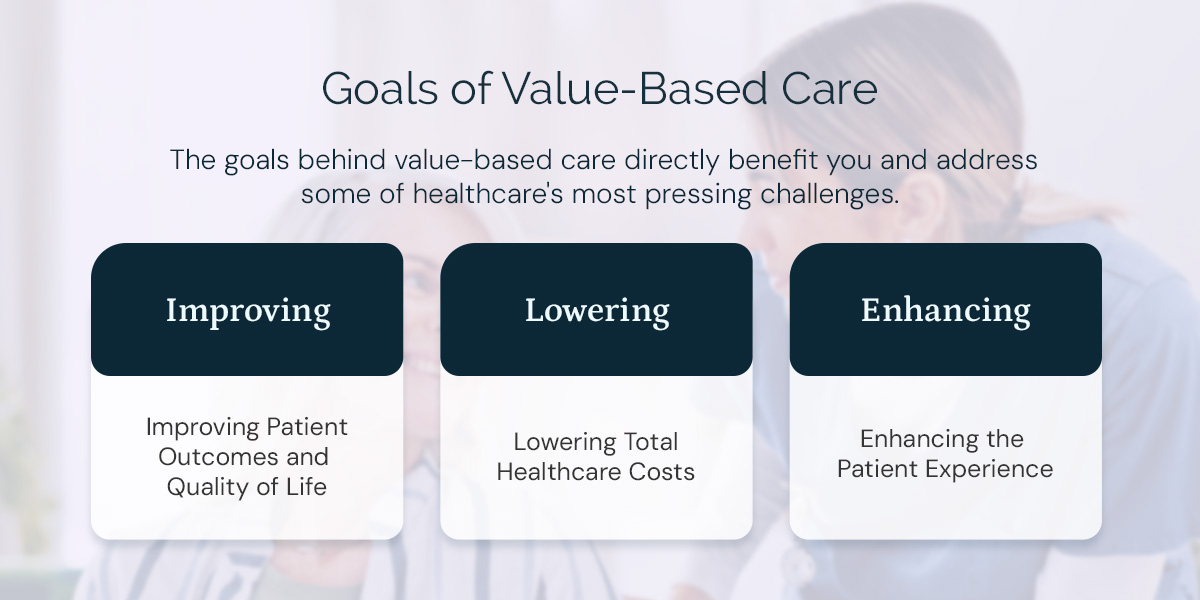
Value-based care focuses on your long-term health, not just treating individual symptoms as they arise. This model helps you improve your well-being by proactively managing chronic conditions and promoting holistic health.
According to a Health Affairs study, receiving value-based payment is associated with improved performance in preventive and primary care. When your care team benefits from keeping you healthy, the entire approach shifts toward sustainable, long-term wellness. This is especially important for patients experiencing cancer, where quality of life and comprehensive support can make a profound difference.
Studies demonstrate that value-based healthcare is a transformative strategy for maximizing patient outcomes while minimizing associated costs. This lowers the financial burden on both patients and the system.
By shifting resources toward a more preventive approach, patients can save on high long-term costs. In specialty care, such as oncology, new risk-based models represent the next frontier for effectively managing costs. These models hold the potential to reduce Medicare and specialty spending by $100 billion each year.
In value-based care, you become a partner in your own health journey. This model creates a more coordinated experience where you feel heard and supported. You might notice:
What does value-based care actually look like in practice? Here’s what you can expect as a patient in this model.
In value-based care, physicians are encouraged to work collaboratively within care teams, fostering a physician-led, team-based approach. According to the National Cancer Institute, interactions between two or more people help achieve shared patient care goals.
Improving cancer patient outcomes requires efficient communication among patients, caregivers, and clinical staff across multiple specialties. When your care team communicates effectively, you benefit from fewer duplicate tests and more consistent care decisions. This collaboration reduces the burden on you to be your own coordinator and helps address care gaps before they become serious problems.
Value-based healthcare emphasizes preventive health by rewarding providers for positive patient outcomes. The goal is to keep you healthy and manage conditions before they become crises, leading to better long-term health. Value-based care provides a strategic framework focused on improving outcomes, reducing hospital-acquired conditions, and preventing chronic diseases.
By scheduling routine screenings and wellness visits, providers can catch potential health issues before they become severe or costly to treat. This approach also addresses your physical, mental, and social needs holistically. This includes access to healthy food, reliable transportation, and general living conditions that directly impact your health outcomes.
Modern technology plays a critical role in making value-based care more accessible. Digital tools empower you to take an active role in your health and give your care team better insights to support you. Technologies that elevate your care experience include:
Technology supports shared decision-making and customized care plans that address your individual needs.
Since 2007, The Oncology Institute has advanced oncology with high-value cancer care built on the above principles. Our model allows us to recommend treatments that are most beneficial to you — not what brings in the most profit.
We offer evidence-based cancer care to nearly 2 million patients, including access to clinical trials and innovative care models. Our mission is to empower patients through innovation and state-of-the-art care.
Your health outcomes and quality of life are always at the center of every decision we make. To experience compassionate, patient-centered cancer care, request an appointment today.